

Upper Park Wood Nature Reserve
Location
OS Map Reference
SE 1480 1286View on What3Words

Know before you go
Dogs
When to visit
Opening times
Open at all timesBest time to visit
March to MayAbout the reserve
Springtime with Summer Wine
As you gaze out over the Holme Valley from Upper Park Wood, you can imagine seeing Compo, Clegg, Foggy and friends up to their madcap antics in the beautiful, hilly landscape, with its moors, meadows and drystone walls.
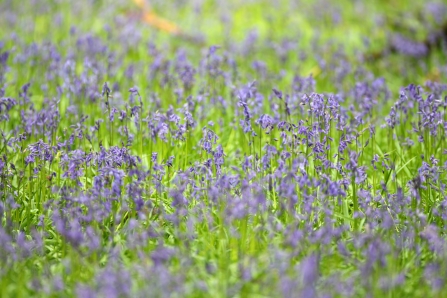
The reserve is a young, planted wood surrounding a small area of ancient woodland. It was probably once part of a game park for deer and wild boar, belonging to the ancient Manor of Almondbury. Mostly made up of oak and holly, the wood is at its most enchanting in spring, when bluebells flood the floor of the hazel coppice and the woodland birds are in fine voice.
Encounter a variety of habitats and enjoy views as you explore the network of paths. Look for the different wildlife that inhabits the woodland edge, the field and path margins, pond, wet areas, hedges, and drystone walls. A small pond, created by damming a stream, is an important refuge for insects and amphibians.
Boosting biodiversity
Until the early 1900s, seams of coal were worked along the valley, and you can see evidence of two coal pits by the steps up the side of the wood.
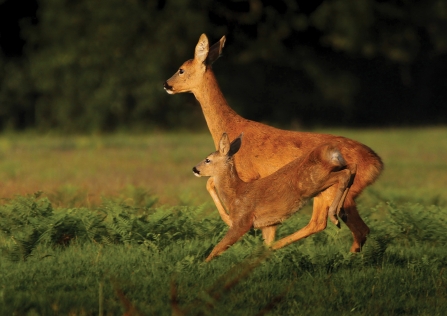
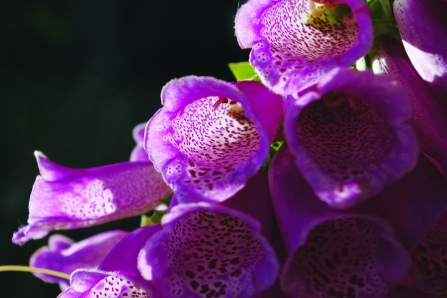
Upper Park Wood took its name from a tiny remnant of ancient deciduous woodland. In winter, hazel is coppiced on rotation to allow sunlight to reach the woodland floor, for the benefit of wildflowers like bluebells, and foxgloves and insects like the comma butterfly. Newly coppiced areas need to be enclosed by deer fencing to prevent roe deer from browsing the regrowth.
Look and listen for great spotted woodpeckers and tawny owls, and watch for barn owls over the surrounding grassland.
Environmental designation
Seasonal highlights
- Spring: Plants - Blackthorn; Wild cherry; Bluebell
- Summer: Plants - Foxglove; Birds - Buzzard
- Autumn: Plants - Fungi
- Winter: Plants - Holly; Mammals - Roe deer
History
The south facing hillside lies on the lower coal measures, made up of layers of shale and sandstone, with coal seams above some of the sandstone beds. Until the early 1900s the richer seams were worked along the valley. Evidence of two coal pits can be seen adjacent to the steps up the side of the wood, marked by the profuse growth of Western gorse.
Designated as a Local Nature Reserve in 1987, the site took its name from a tiny remnant of ancient deciduous woodland. Owned by Kirklees Metropolitan Council and managed jointly with Yorkshire Wildlife Trust, the site has grown with the acquisition of adjacent fields which have since been planted with a variety of native trees and shrub species. Much of the woodland management is carried out by a group of enthusiastic volunteers with the aim of maintaining and increasing biodiversity where possible.
Directions
Public transport
A bus service passes the nature reserve, or take a bus from Huddersfield to Holmfirth and alight at Honley Bridge then take Northgate. Nearest train station at Honley, an hourly service runs between Huddersfield and Sheffield.
By car
Approach via Northgate, a left turn off the A616 from Huddersfield, immediately after the A6024 turn-off towards Holmfirth. After a steep climb, of about 0.75 miles you reach a high wall which can be parked against.
(c) Neil Aldridge

Magical Wildlife Moment
The gentle t-wit and t-woo between tawny owls at dusk.

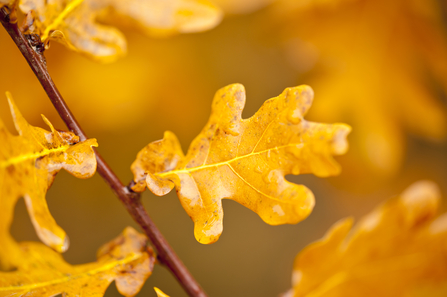
The autumn colours were even more beautiful when the sun came out
Photo Credit - Telling our Story Volunteer, Sara


