Tide and Seek: Fish Surveying at Spurn

Tide and Seek: Fish Surveying at Spurn

Wilder Humber Intertidal Fish Survey Volunteers - Simon Tull

Telling our Story volunteer Simon headed to Spurn, Yorkshire’s 'Lands End' to join the Wilder Humber’s restoration team and learn about the Intertidal Fish Survey they are running. This is an important addition to their programmes which are re-establishing seagrass and native oyster communities in the Humber Estuary. Like so many of the Trust’s activities, the survey relies heavily on the help of volunteers.

The day began with a briefing from Georgia, Yorkshire Wildlife Trust Marine Restoration Assistant and lead for the day. Safety first - everyone has to wear chest waders and a life jacket. Georgia told us that there could be poisonous jellyfish and lesser weever fish around, so gloves also had to be worn. The Trust's website describes weever fish as grumpy mouthed and venomous, which put me in mind of one or two people I used to work with. This was enough to get them a place on my “to be avoided” list. However, Pat - one of the more experienced volunteers, was slightly dismissive of the hazard they represent, “the sting is no worse than a wasp ” he tried to assure us. 

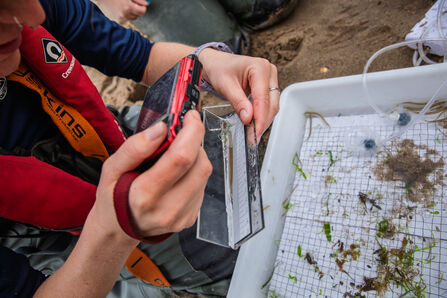
Georgia explained the equipment we’d use, including the long seine net, buckets, sample trays, scoop nets, measuring gauges, and aerators to keep the fish alive during identification and counting. Their health and safe handling are the top priority. 

Briefing completed, we walked down the beach to collect the truck carrying all the gear Georgia had listed. Spurn offers many sights such as the foreshore is covered in rocks and pebbles, some with fossils like corals and oysters. Little and Sandwich Terns flew by, their shrill calls ringing over the crashing waves. Butterflies flitted around the bushes and grasses above the beach - they seem to have thrived in this dry summer. 

We arrived on site very close to the lighthouse and unloaded everything, then donned our “PPE”. Here’s what the well-dressed fish surveyor is wearing this season, as modelled by Georgia, Jess, Aimee, Sarah, Pat and Clare

The Wilder Humber Intertidal Fish Surveying Team - Simon Tull

The Wilder Humber Intertidal Fish Surveying Team - Simon Tull

We first checked the sea conditions - the water was a calm and clear; Georgia told us that this could work against us as the fish can see the net when the sea is like this and - unsurprisingly, but rather unsportingly - make a run for it.

Next, because the team doesn’t work in water any deeper than the hip height of the shortest person, Georgia waded in to check how far out to sea we could go.

Georgia Bennett, Marine Restoration Assistant - Simon Tull

Georgia checking the sea was a safe and appropriate depth for surveying - Simon Tull

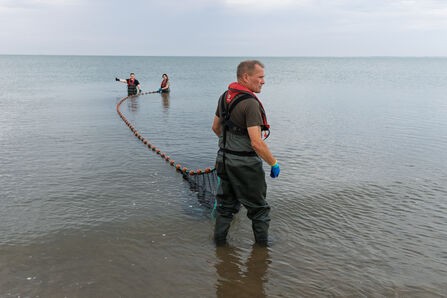
Then it was time to unfurl the seine net and get it ready to use. The net has to be set to hang vertically in the water with its bottom edge held down by weights and its top edge buoyed by floats. Here’s the team getting it ready...

Intertidal Fish Surveying, getting the net ready - Simon Tull

The team carefully unfurl the seine net and get it ready to use for surveying - Simon Tull

The team then straighten it out to get it hanging nicely in the water...

Hanging the net for intertidal fish surveying wilder humber - Simon Hull

Hanging the net for intertidal fish surveying, Wilder Humber - Simon Hull

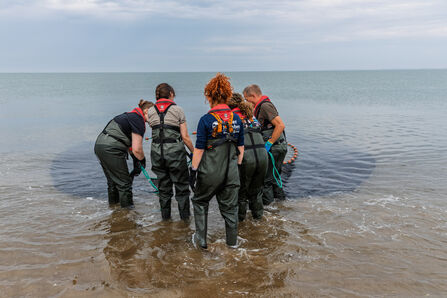
Then the team dragged the ends of the net round, working together to enclose the fish, with Georgia guiding...

Intertidal Fish Surveying Wilder Humber - Simon Tull

Intertidal Fish Surveying Wilder Humber - Simon Tull

To finish things off, Georgia dragged the last folds in, while Pat, Sarah, Aimee and Jess kept the sides of the net high to prevent any escapes.

Intertidal Fish Surveying Wilder Humber - Simon Tull

Dragging the net in, intertidal fish surveying - Simon Tull

The next task was to use a small net to get the fish into buckets and see what we’ve caught.  Further investigation revealed one of the weever fish Georgia had warned us about. The spines on its dorsal fin contains a cocktail of toxins, providing protection from predators and fish surveyors alike. We promptly released it.  The rest of the catch was transferred gently to shallow trays for counting and identification.

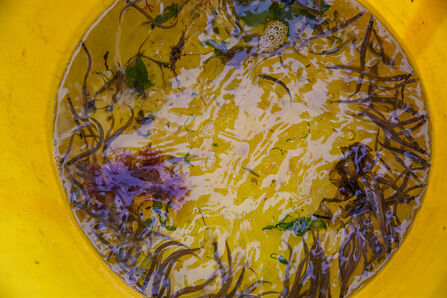
Lesser sand eels dominated - they crowded against the edges and corners of the tray wiggling like the excited members of a swimming class. Occasionally one would break free and zip around, throwing a few moves to show off to the rest. There were sprats too, which flashed silver and blue as they swam. Once the catch had been documented, everything was returned carefully to the sea.

Lesser weever Fish - Simon Tull

Lesser weever Fish - Simon Tull

Lesser sand eels - Simon Tull

The survey tray revealed that the lesser sand eels dominated - Simon Tull

There was a keen sense of anticipation with every trawl….the star turn of the day for my money was a lovely little flounder...although a goby also had its admirers. 

Flounder and goby, Intertidal fish surveying - Simon Tull

A flounder and a goby were among the favouties to be surveyed on the day - Simon Tull

The session soon ended with the falling tide. The fish we caught and released are part of an ecosystem that includes seagrass meadows, oyster banks, and terns we saw on our beach walk so it was really encouraging to see how much we had caught. 

On our way back, Aimee, Jess, and Sarah all told me they were soon hoping to start marine conservation-related internships or apprenticeships and also highlighted how volunteering is a great way to gain practical experience, build connections, have fun, and enjoy nature. 

Wilder Humber’s ambitious programme seeks to restore marine habitats and species throughout the Humber estuary. Delivered through a pioneering conservation partnership between Yorkshire Wildlife Trust, Lincolnshire Wildlife Trust, and international green energy leader Ørsted it will trial a seascape scale model, combining sand dune, saltmarsh, seagrass, and native oyster restoration to maximise conservation and biodiversity benefits. Find out more about this innovative project here