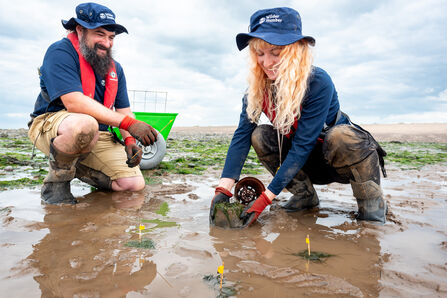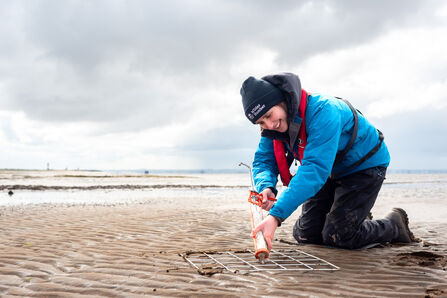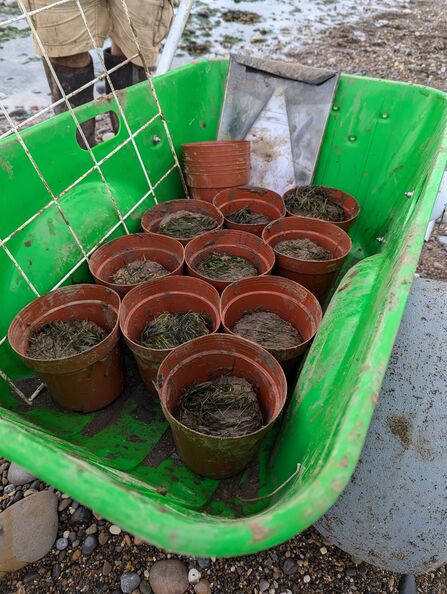
Led by Yorkshire Wildlife Trust and Lincolnshire Wildlife Trust, with support from Ørsted, ReMeMaRe and the Water Environment Improvement Fund, the project aims to plant 10 acres of seagrass each year across the Humber estuary. The latest trial, monitored over a full growing season, tested three planting techniques to identify the most effective methods for re-establishing this vital underwater habitat.
Seagrass is the only flowering plant that can live entirely in seawater and is one of the world’s most powerful natural tools for tackling climate change. Globally, it captures carbon up to 35 times faster than tropical rainforests, helps protect coastlines from storms and erosion, and improves water quality by absorbing pollutants. In the UK, seagrass meadows act as crucial nurseries for young fish, including bass and sand eel, and support important bird species such as brent geese. There are four species of seagrass found in the UK: two species of tasselweeds and two Zostera species, commonly known as eelgrass. Wilder Humber is reintroducing dwarf eelgrass (Zostera noltii).
Although the Humber once supported vast seagrass meadows - historical maps suggest they covered around 1100 acres - this habitat declined dramatically during the 20th century to just 12 acres. This rapid loss has been attributed to industrialisation, water pollution, disease and the loss of natural coastal space. Today, restoration work is essential to bring this vital habitat back to the estuary.
In this new trial, Wilder Humber compared three planting approaches: direct injection of seeds into the seabed using Dispenser Injection Seeding (DIS), seeds placed in hessian “seed bags”, and the transplanting of small intact patches of seagrass, known as core transplants. By monitoring both the number and size of patches that developed, the team has gained a clear understanding of what works best in the Humber’s challenging conditions.
The results showed that DIS and transplanting delivered by far the strongest recovery. DIS created the highest number of new patches, demonstrating that it is highly effective for rapid early colonisation. It produced significantly more small patches than any other method; around 2.5 to 3 times more than transplanting, and approximately 3.5 times more than the unplanted control area.
Transplanting produced larger, stable patches. By moving small sections of healthy seagrass - complete with roots, shoots and the natural community of microorganisms that support them - this method gives new meadows a significant head start. The transplants showed exceptional success, with over 92% surviving and expanding by an average of more than 20 centimetres beyond their original footprint. Many also produced reproductive structures within the first growing season, a strong indicator that they are on the path to becoming self-sustaining meadows. Importantly, the donor areas where the cores were taken from also recovered within the first year, showing no significant difference compared to unharvested areas.