
Hedgelaying Volunteer Training - Howard Roddie

Hedgelaying Volunteer Training - Howard Roddie
Hedgelaying Volunteer Training - Howard Roddie
On the left, as we entered Cali Heath, we could see a neat and tidy hedge. On the right was a tangled mass of bramble, straggly trees and deadwood. 25 years had passed since this strip last looked anything like the hedge to the left. We were probably 10 years late, but nature being nature, the hedge was still doing its job. At first the task looked daunting. We had no idea where to start or what we were trying to do. Surely the hedge on the left was brand new? It couldn’t have been like this? Well we were here to learn.

Cali Heath Nature Reserve - Howard Roddie
Cali Heath is easily missed on the left as you travel towards Hull from York on the A1079. Situated between Wilberforce and Barmby on the Moor, Cali is shortened from California - a reference to the California gold rush. Whether it was named as such due to the richness of the land or because people moved to the area to make their fortunes on what was once known as 'Poor's Allotments' is up for debate. Not up for debate is the state of the heath. Whilst it looks OK, the sandy acidic soil it is made up of should be lowland heath like its cousin Allerthorpe common, a few miles to the south. It should be full of heather. Long term, the aim is to restore the heather and other lowland heath species to their former glory. There is some heather clinging on in small patches which gives us hope.

A small amount of heather has managed to cling-on at Cali Heath - Howard Roddie
As part of the recovery process YWT are grazing the heath in order to tip the balance towards the heathland plant species. To date grazing with Dexter Cattle, Hebridean Sheep and YWT’s first herd of goats have all been used. Grazing animals need to be kept on the reserve. This requires a high standard of fencing which is why we were trying to figure out how to turn 200 or so metres of scrubby growth into a barrier that would keep all of our grazers on the heath.

Goats are being used as part of the Conservation Grazing Scheme at Cali Heath - Howard Roddie
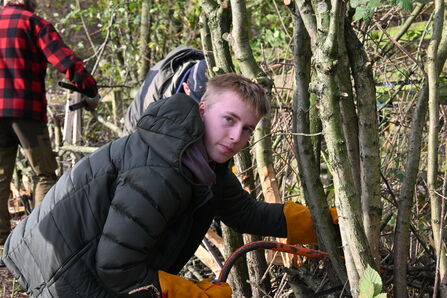
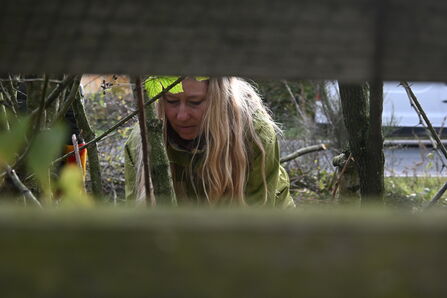
You can’t learn to lay a hedge from a book or online or even in a classroom. There is only one way. You have to be shown and you have to get stuck in. It’s an ancient skill that has to be passed on person to person through the generations. There is no GCSE or PhD (although there is a National accreditation system). We were lucky to have Mike Dudding, a tree surgeon and former National Trust ranger with us. He explained that we were going to learn the same way he had learned. In pairs, we picked a section of old hedge and started to clear brambles, deadwood and years of other detritus. As we cleared out the debris, the shape of the old hedge appeared and we could select the healthiest growth. Looking up was important to pick out healthy growth.

Clearing brambles and deadwood for hedgelaying - Howard Roddie
Looking to the left and right helped us to space the retained growth. Initial confusion was turning to informed questions and guidance about selecting the best growth to keep. Eventually we ended up with long straight vertical branches that we were going to lay down horizontally to form the new hedge. Hence the term hedgelaying.

Preparing for hedgelaying - Howard Roddie

Hedgelaying Cali Heath - Howard Roddie
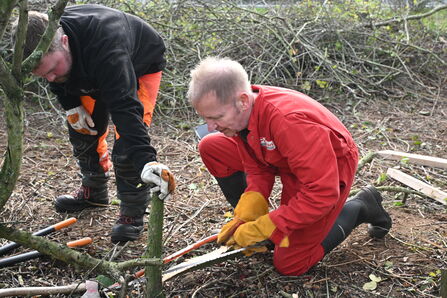
Once we had created a section, we had to lay them horizontally. This is not just a case of bending them over as they would be impossible to handle and would try to spring back up which, apart from being dangerous, would compromise the integrity of the hedge. So we learned to pleach the stems. This involves cutting vertically into the stems with an axe at least half way across until it can be bent over. At first it seems like we are breaking the branch, but Mike explained that we were harnessing the trees amazing abilities to regrow from broken stems. In the picture below we have enough attached wood for growth, and, if you look carefully, a fresh shoot ready to grow.

Pleaching Technique, Hedgelaying - Howard Roddie
The pleacher, as the partially attached stem is known, is then laid horizontally and twisted between wooden stakes to form a straight line that is impenetrable by livestock. Extra cuts can be made to the stems to allow them to twist round the stakes and stay in line. In the spring, new vertical growth will spring from the newly laid pleachers.
As I said earlier, you can’t learn hedgelaying from a book, so I’ve left a lot out of this description. For instance we were laying in a mix of Yorkshire and Derbyshire styles - there are many styles of hedgelaying depending on available trees, purpose of the hedge and local techniques.

Instructor Mike Dudding inserting wooden posts to provide a straight line for hedgelaying - Howard Roddie
Fences are not great at keeping livestock in as demonstrated by the hungry goat below...
Hedges have long been used to mark ownership boundaries and to designate fields for crop rotation systems. They are also important as habitats and corridors for wildlife - they support plants, insects, birds and mammals providing food, shelter and a safe space for movement between areas. Farm animals use them for shelter too - especially lambs. In crop growing areas where hedges have been removed, topsoil has been blown off, degrading the quality of arable land. They also act as a great carbon store - A study by Leeds university has established that the soil under every hectare of hedgerow contains 40 tonnes more carbon than managed grassland. This does not include the carbon in the hedge itself. Increased hedgelaying and planting is part of current government strategy.

Goats having a munch Cali Heath - Howard Roddie
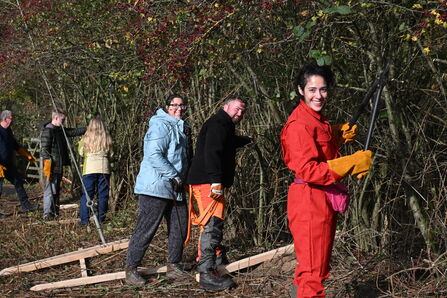
We had quite a team on the day. Alongside Mike, we also had Dave Powell (Living Landscapes Officer – Vale of York) and Matt Samuel (Living Landscapes Assistant ) who look after Cali Heath for the Trust. It was especially good to see Rachel Loffman, our Volunteering Support Officer getting stuck in. Amongst the volunteers we had a mother and son team all the way from Holmfirth. Zoe and Harry Stainton are established volunteers. Harry is one of our youngest volunteers and is embracing the opportunities that YWT volunteering gives him to work as part of a team, learn new skills and potentially help him decide about a career in nature and the environment. His mother, Zoe, is a sculptor who has now learned a bit about creating living sculptures at the edge of fields. From the York group we had Ben Davey who was keen to point out how volunteering outside gave him a real zest for life. Melena, an actor visiting from Costa Rica, wanted to see how nature is managed in the UK. In Costa Rica, nature is known as “Green Gold”.
You can learn more about hedgelaying here - if you are a current volunteer then keep an eye out in the Volunteer Learning and Development programme. It’s a very satisfying thing to do and the results will be there to see for years. If you're not yet a volunteer with us and you're interested in finding out more about what opportunities we have then visit the volunteering section of our website here
Hedgelaying Team Cali Heath - Volunteer Training Day Howard Roddie
Hedgelaying Volunteer Training - Howard Roddie
Hedgelaying Volunteer Training - Howard Roddie
Hedgelaying Volunteer Training - Photo by Melena